AI Agent Architecture Explained: How Modern AI Agents Actually Work
AI Agent Architecture Explained: How Modern AI Agents Actually Work
Artificial Intelligence has evolved far beyond simple chatbots. Today's AI agents don't just answer questions—they can understand goals, break complex problems into manageable tasks, retrieve information from multiple sources, use external software tools, make decisions, and execute real-world actions with minimal human intervention.
From automating customer support to managing enterprise workflows, AI agents are transforming how businesses operate. But what enables these intelligent systems to perform such sophisticated tasks?
The answer lies in AI Agent Architecture—the structured framework that allows an AI agent to perceive, reason, plan, remember, interact with external systems, and continuously improve its performance.
Whether you're a business leader exploring AI automation or a developer building intelligent applications, understanding AI agent architecture is the first step toward creating reliable, scalable, and production-ready AI systems.
Related Reading: If you're new to intelligent AI systems, read our deep-dive on AI Chatbots vs AI Agents to understand how modern AI agents differ from traditional conversational AI and why architecture is the foundation of autonomous decision-making.
What Is AI Agent Architecture?
AI agent architecture refers to the collection of components and processes that work together to enable an AI system to operate intelligently.
Instead of generating a single response like a traditional chatbot, an AI agent continuously evaluates information, plans tasks, retrieves knowledge, interacts with software tools, and executes actions until a goal is achieved.
Think of AI agent architecture as the blueprint of an intelligent employee. Just as a skilled professional relies on experience, memory, planning, and tools to complete a project, an AI agent combines multiple capabilities to solve complex business problems.
Why AI Agent Architecture Matters
Large Language Models (LLMs) are incredibly powerful, but on their own they have limitations.
Without a proper architecture, AI systems struggle with:
- Long-running workflows
- Multi-step reasoning
- Context retention
- Real-time information
- External software integrations
- Reliable decision-making
Modern AI agent architecture transforms a language model into a complete intelligent system capable of solving real business challenges.
Building an intelligent AI agent is only one part of the equation. Read our guide on Building Safe AI Agents: Best Practices for Production to learn how organizations implement guardrails, reduce hallucinations, and deploy trustworthy AI systems in production.
From Prompt to Action: The AI Agent Workflow
Unlike traditional chatbots that simply generate responses, modern AI agents operate through a structured architecture that combines reasoning, memory, planning, external tools, and continuous evaluation. Each component has a specific responsibility, enabling the agent to understand goals, make intelligent decisions, execute tasks, and continuously improve its performance.
Think of an AI agent as a highly skilled employee rather than just a chatbot. Instead of only answering questions, it can understand objectives, create a plan, gather information, use software tools, perform actions, verify results, and deliver the final outcome.
This ability to integrate with CRMs, databases, APIs, and business applications is what makes AI agents powerful automation tools. To see how organizations use these capabilities to streamline workflows and reduce manual effort, explore How AI Automation Can Save Your Business.
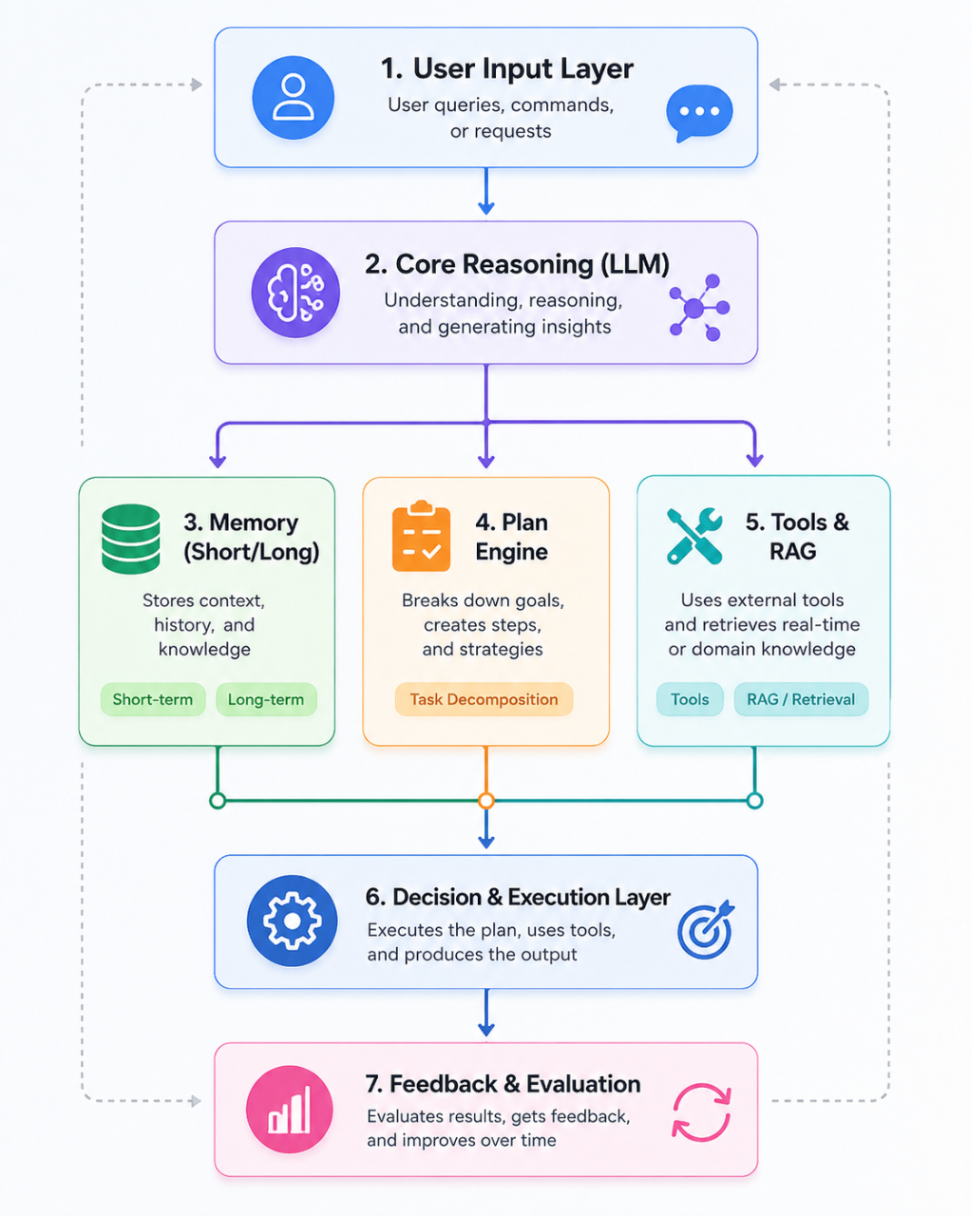
Breaking Down Each Component
1. User Input & Intent Recognition
Every workflow begins with a user's request. The AI identifies the user's intent, extracts context, and understands the desired outcome.
Example
"Analyze last month's sales data and email a summary to my manager."
The AI recognizes that this task requires data retrieval, analysis, report generation, and email delivery.
2. Large Language Model (LLM)
The LLM serves as the reasoning engine.
It enables the AI agent to:
- Understand natural language
- Interpret user intent
- Generate logical plans
- Solve problems
- Produce human-like responses
Popular LLMs include GPT, Claude, Gemini, and Llama. However, the language model is only one part of the overall architecture.
3. Memory Layer
Memory enables AI agents to retain information over time.
Short-Term Memory maintains the current conversation and recent context.
Long-Term Memory stores historical conversations, user preferences, business rules, and organizational knowledge.
Memory allows AI agents to provide personalized, context-aware experiences instead of treating every conversation as brand new.
4. Planning Engine
Complex tasks are broken into manageable steps before execution.
Example workflow:
- Retrieve sales data
- Analyze revenue trends
- Create visual charts
- Write executive summary
- Generate presentation slides
This decomposition dramatically improves reliability.
5. Knowledge Retrieval (RAG)
RAG allows AI agents to retrieve trusted information before generating a response.
Sources include:
- Company documentation
- Internal knowledge bases
- Databases
- PDFs
- APIs
- Websites
This improves accuracy while reducing hallucinations.
6. Decision Engine
Typical decisions include:
- Should additional information be retrieved?
- Is clarification required?
- Which tool should be used?
- Should the task be escalated to a human?
7. Tool Calling Layer
Examples include CRM platforms, ERP systems, email services, calendars, databases, search engines, Slack, payment gateways, and cloud storage.
8. Task Execution
Examples include sending emails, updating CRM records, creating reports, scheduling meetings, processing invoices, and managing customer requests.
9. Evaluation & Feedback
Evaluation may include:
- Accuracy checks
- Task completion validation
- Hallucination detection
- Compliance verification
- Performance measurement
Traditional Chatbots vs Modern AI Agents
| Traditional Chatbot | Modern AI Agent |
|---|---|
| Responds to prompts | Understands goals |
| Limited memory | Persistent memory |
| No planning | Multi-step planning |
| Limited integrations | Uses APIs and enterprise tools |
| Static conversations | Dynamic workflows |
| Reactive | Goal-oriented and autonomous |
Real-World Applications of AI Agent Architecture
AI agent architecture powers everything from customer support and sales to finance, HR, and operations. If you're looking for practical examples of AI in action, read How AI Automation Can Save Your Business to discover how organizations automate repetitive tasks, improve productivity, and accelerate business growth with AI.
Customer Support
- Resolve customer queries
- Retrieve account information
- Escalate complex issues
Sales
- Qualify leads
- Generate proposals
- Schedule meetings
Human Resources
- Screen resumes
- Answer employee questions
- Automate onboarding
Finance
- Process invoices
- Generate financial reports
- Detect anomalies
Operations
- Monitor workflows
- Automate approvals
- Coordinate enterprise systems
Best Practices for Building Reliable AI Agents
Building an effective AI agent requires more than choosing the right architecture. Security, governance, and responsible deployment are equally important. Learn more in Building Safe AI Agents: Best Practices for Production to discover how organizations deploy secure, reliable, and production-ready AI systems.
- Clearly define business objectives.
- Use high-quality data sources.
- Implement secure tool integrations.
- Store only relevant long-term memory.
- Continuously evaluate outputs.
- Keep humans involved in high-risk decisions.
- Monitor performance and optimize regularly.
A strong architecture balances intelligence, security, scalability, and governance.
The Future of AI Agent Architecture
Key trends include:
- Multi-agent collaboration
- Long-term memory systems
- Autonomous workflow orchestration
- Voice-enabled AI agents
- Model Context Protocol (MCP)
- Enterprise AI governance
- Advanced AI evaluation frameworks
Conclusion
Modern AI agents are much more than conversational assistants. Their intelligence comes from a carefully designed architecture that combines reasoning, memory, planning, knowledge retrieval, decision-making, tool integration, execution, and continuous evaluation.
Understanding AI agent architecture helps organizations move beyond simple automation toward intelligent systems that can adapt, collaborate, and deliver measurable business outcomes.
As businesses continue adopting AI at scale, investing in robust AI agent architecture will be essential for building secure, reliable, and high-performing solutions.
At SAMYORA, we help organizations design, develop, and evaluate enterprise-grade AI agents that automate workflows, enhance decision-making, and drive innovation. Whether you're building your first AI assistant or scaling enterprise AI initiatives, a strong architecture is the foundation of long-term success.
If you're beginning your enterprise AI journey, start by understanding AI Chatbots vs AI Agents to see how modern AI agents go beyond conversational AI. Next, explore Building Safe AI Agents: Best Practices for Production to learn how to deploy AI responsibly, and discover How AI Automation Can Save Your Business for practical examples of how AI transforms everyday business operations.
Related Posts
Engineering•10 min read
Bank of Baroda Data Breach 2026: How One Compromised Employee Email Created a Massive Security Risk
The 2026 Bank of Baroda data breach shows why securing core banking systems is not enough. Learn what happened, what data was reportedly exposed, how email compromise enabled the incident, and the security controls enterprises should implement.
Engineering•12 min read
What Is a GTM Engineer? Skills, Responsibilities & How AI Is Transforming Modern Go-to-Market Teams
Learn how GTM Engineers use AI, automation, and CRM integrations to streamline go-to-market strategies, improve sales efficiency, and drive business growth.
Engineering•7 min read
Building Safe AI Agents: Best Practices for Production Deployment
Learn the best practices for building safe, secure, and reliable AI agents for production. Discover common risks, evaluation methods, and benchmarking strategies.